


“We need to ensure WIPO stays in keeping with its core mission to promote IP protection. Too often proposals are entertained that weaken IP rights.” – USPTO Director John Squires
The U.S. Chamber of Commerce’s Global Innovation Policy Center (GIPC) today released its 2026 International IP Index, which flagged concerning trends about the “growing erosion of IP leadership” among the world’s high-performing economies, according to the report’s authors.
In particular, the report noted that scores in eight EU Member States have declined this year, although the top ten rankings remained the same from 2025. The United States was again number one, with a relatively stable score of 95.15% compared with last year’s 95.17%.
The U.S. score held fast despite several anti-IP policy changes introduced by the Trump Administration over the last year, such as the Executive Order on Most Favored Nations, and the Biden-era National Institutes of Health “Promoting Equity Through Access Planning” guidelines, which were adopted by the Trump administration in October 2025.
The eight EU states that saw decreased scores are:
- France (#3: 93.51% 2025/ 93.11% 2026);
- Germany (#4: 92.42% 2025/ 92.02% 2026);
- Sweden (#5: 92.09% 2025/ 91.72% 2026);
- Netherlands (#6: 91.26% 2025/ 90.89% 2026);
- Ireland (#8 – 89.51% 2025/ 89.13% 2026);
- Spain (#9 – 86.74% 2025/ 86.34% 2026);
- Italy (#12 – 84.34% 2025/ 83.96% 2026); and
- Hungary (#14 – 77.74% 2025/ 77.36% 2026).
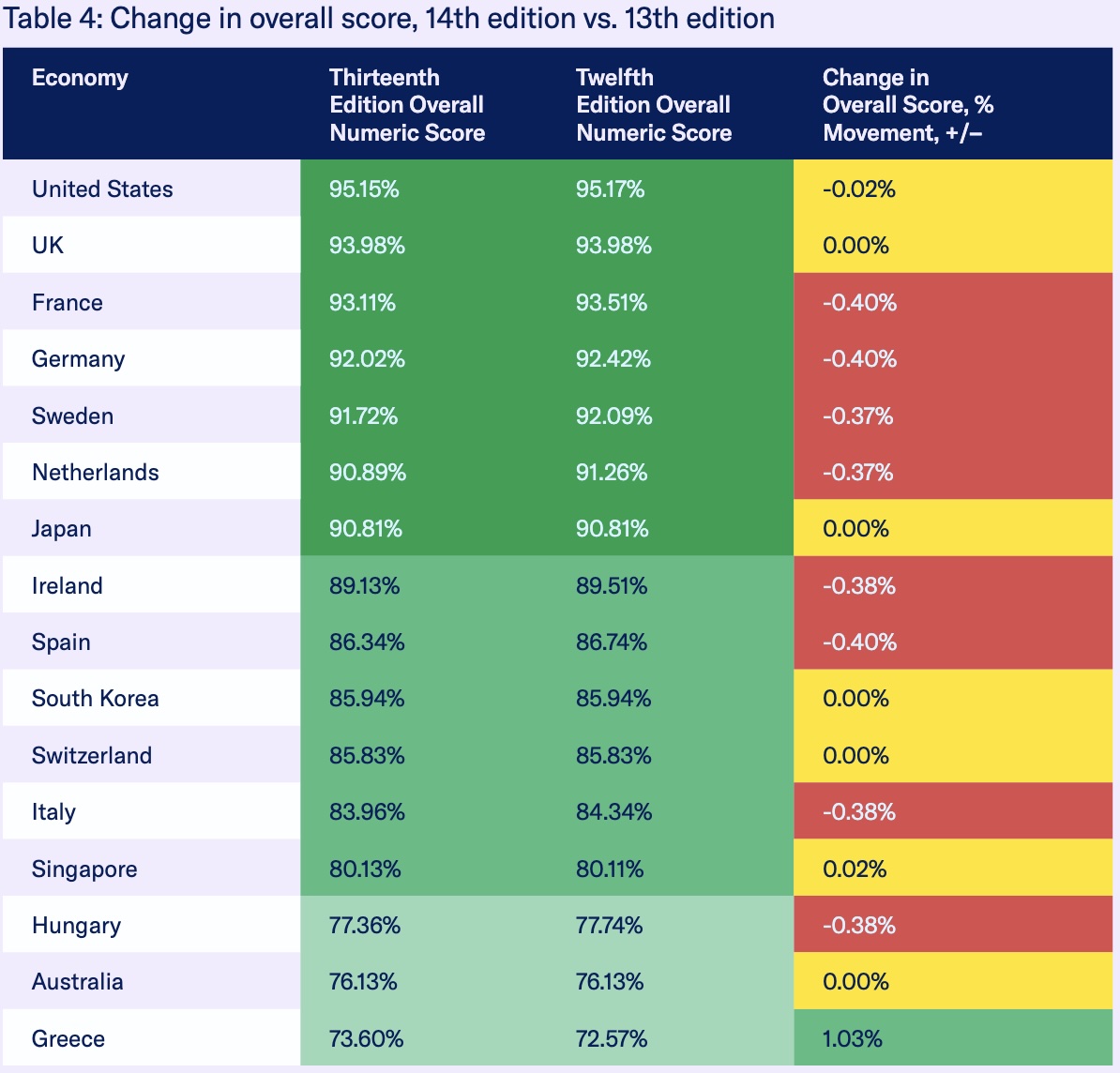
2026 IP Index
In a webinar held Thursday to promote the launch of the Index, U.S. Patent and Trademark Office (USPTO) Director John Squires said the report highlights an “unmistakable and concerning trend” that shows the IP frameworks of advanced economies are in “atrophy” and that risks normalizing lower global standards for innovation protection at a time when the reverse should be true, due to rapid technological expansion.
Squires also sharply criticized the World Intellectual Property Organization (WIPO) in his remarks, commenting that the Index results can be tied to “an increasingly strong warning signal that we see emanating from WIPO that demands prompt attention.”
WIPO has received criticism from the IP community in recent years for Director Daren Tang’s focus on outreach to developing nations, particularly with respect to the 2024 “WIPO Treaty on Intellectual Property, Genetic Resources and Associated Traditional Knowledge,” which established a mandatory disclosure requirement of the country of origin if claimed inventions are based on genetic resources or traditional knowledge. There have also been concerns raised about discussions around exceptions for AI training in the copyright context.
Squires commented today:
“We need to ensure WIPO stays in keeping with its core mission to promote IP protection. Too often proposals are entertained that weaken IP rights or attempt to redefine IP rights in ways that undermine the incentives that drive innovation, the incentives that drive investment, the incentives that drive technological leadership. That is not what WIPO was created to do. WIPO itself states it is the United Nations agency that serves the worlds’ innovators and creators, ensuring that their ideas travel safely to the market and improve lives everywhere. The Index you see tells a different story, and from what we’re observing in both policy and structure it seems the mission is being forgotten. Someone should remind them. We will.”
The report and panelists at the Chamber’s webinar today also pointed to recent EU policy changes that have weakened IP protections. With respect to pharmaceutical patents, the EU in December 2025 introduced legislative changes under the General Pharmaceutical Legislation “to almost all facets of the biopharmaceutical market authorization process and related IP incentives, including patent rights,” said the report. This includes expansion of the so-called Bolar exemption, which allows innovators to use a patented invention for non-commercial purposes, such as using data for testing and regulatory approvals. The legislation extended this exemption to activities such as “conducting health technology assessments, obtaining pricing and reimbursement approvals, and submitting procurement tender applications,” said the report.
Jon Santamauro of AbbVie, who spoke on the panel held during today’s launch of the Index, said that expanding this exemption to include commercial activities “leads to uncertainty.” He also noted that the period of exclusivity for the EU Regulatory Data Protection has been reduced that result in patent holders potentially losing up to 20% of their exclusivity period. These are “negative signals,” Santamauro said.
On a positive note, the Index also found that 20 economies improved their overall score: the United Arab Emirates (+4.72%), Ecuador (2.81%), Malaysia (+1.42%), and Brunei (+1.42%) saw the largest increases in overall score. “This demonstrates that targeted reforms can still strengthen IP frameworks, even amid broader global stagnation,” said a summary of the report. However, 27 economies saw little or no improvement in 2026, suggesting that leading economies may be accepting weaker IP standards.
With respect to copyright, countries including Brazil, Greece, Nigeria, Peru, and Poland have strengthened online piracy enforcement, but uncertainty introduced by AI remains a concern.
China moved from the #24 spot in 2025 to #25 this year, with a score of 54.58% both years. The report cited continuing challenges for IP rights holders in China such as patent term restoration hinging on a first global launch in China and problems with effective patent enforcement.